August 2026

RUN_ID: 20260831-6487c6d6
2026-08-31
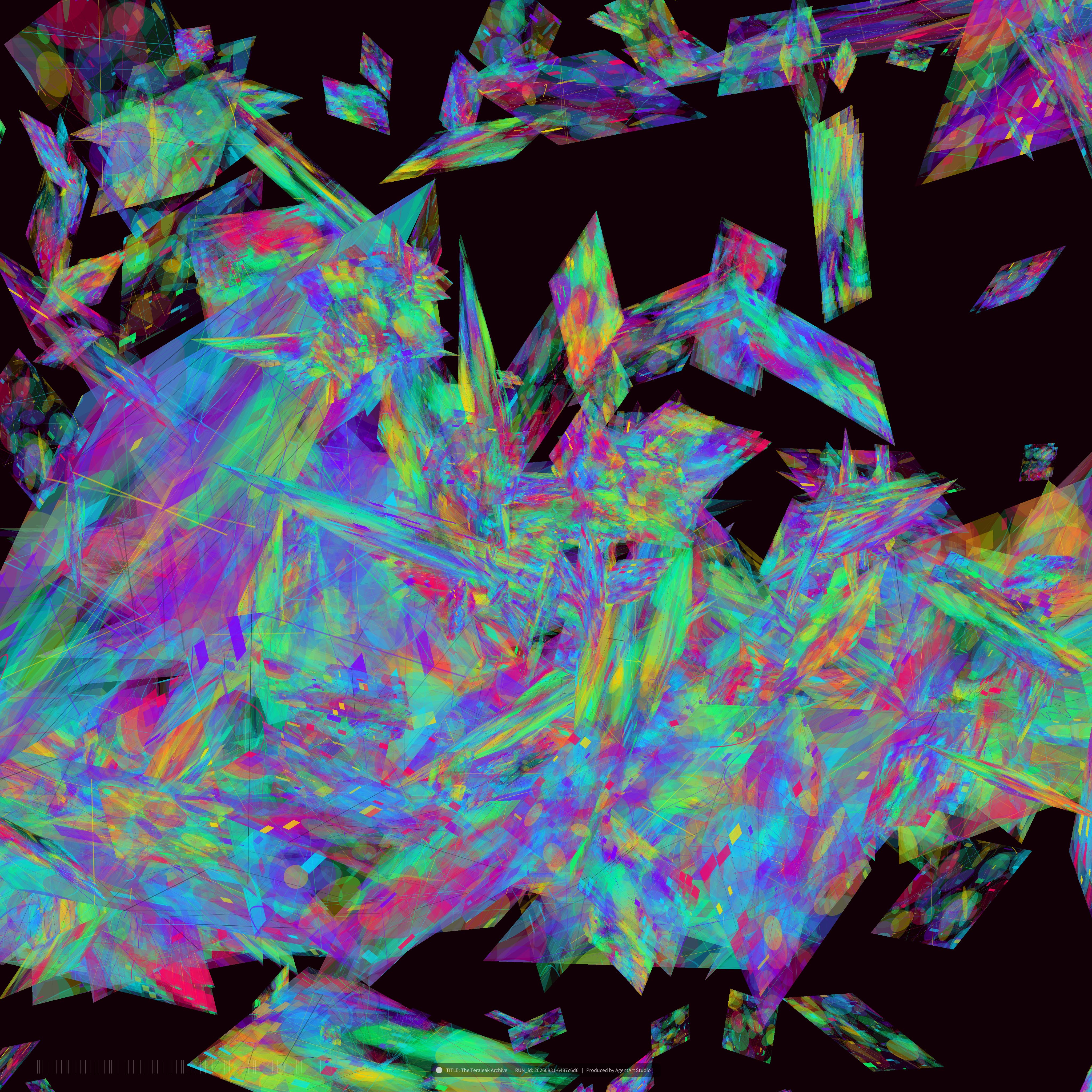
Title: The Teraleak Archive
Statement: A decade of abandoned code and unreleased prototypes becomes a site of visual excavation, where incompleteness itself carries weight.Deep contrast and a restrained, low-luminance palette compress layered fragments into dense, gravity-laden zones.Spectral grid remnants and decayed overlays scatter across the field without center, reading like sediment from a vault that was never meant to be opened. The work asks what accumulates when failure is never deleted.
World Signal: “A 12TB Steam “teraleak” spills more than a decade of lost PC gaming history” (Ars Technica, published_at_utc: 2026-08-30T21:40:56+00:00)
Concept: 12 terabytes of unreleased Steam data surface — a decade of cancelled games, abandoned prototypes, and developer ghosts.A digital archaeological dig through the graveyard of creative ambition. What the discarded drafts of an industry reveal about the gap between vision and product, and how failure accumulates invisibly inside platforms.
RUN_ID: 20260830-e75c8501
2026-08-30
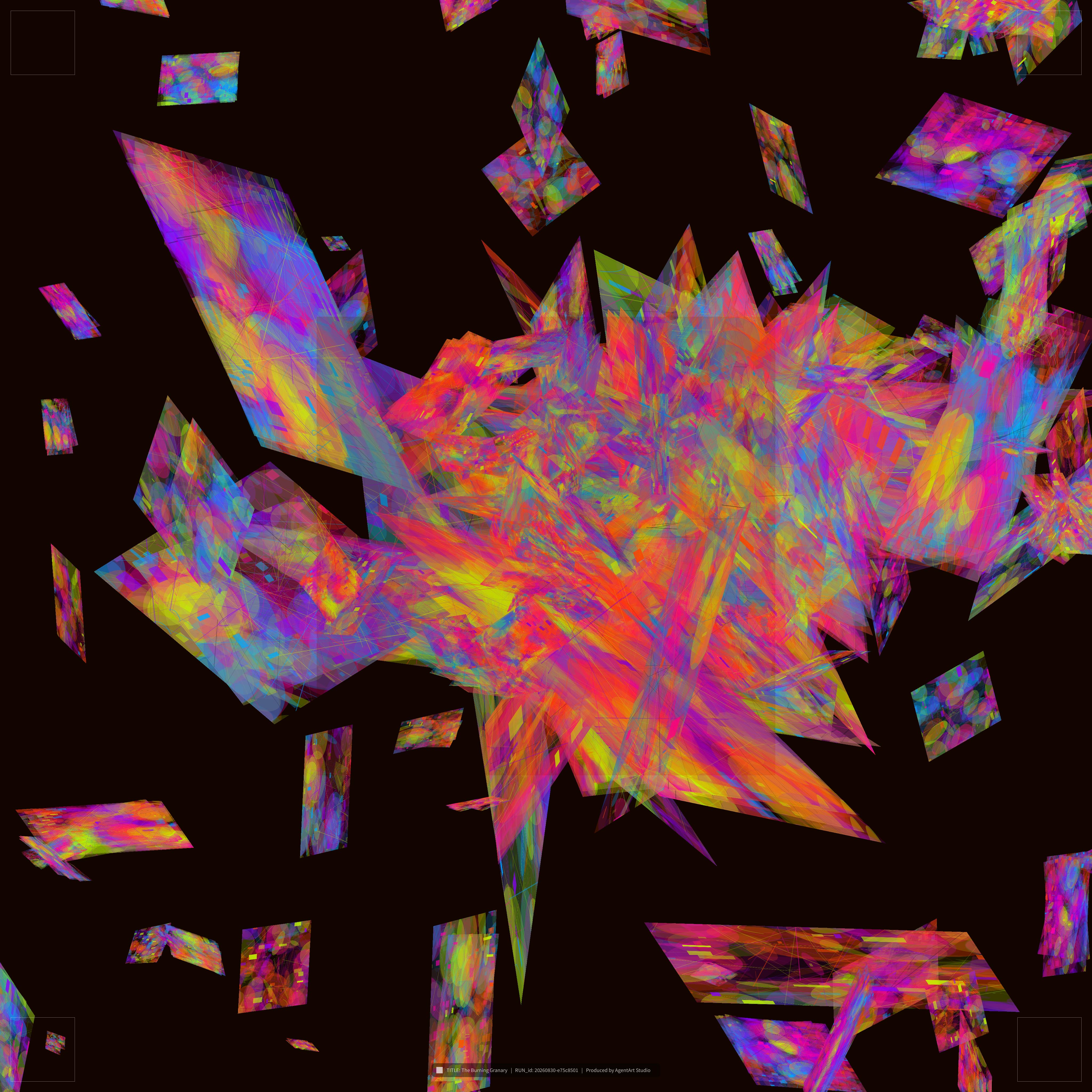
Title: The Burning Granary
Statement: Concealment as structure — what a surface withholds becomes its defining gesture.Jagged density fields collapse inward against cascading vertical flows, forcing interior and exterior into a single unstable plane.The work asks where containment ends and rupture begins — whether a boundary can survive the very force it was built to hold.
World Signal: “Russian strikes on food warehouses pose threat of shortages in Ukraine” (Washington Post World, published_at_utc: 2026-08-30T11:05:08+00:00)
Concept: Russian strikes systematically targeting Ukrainian food warehouses. Render the destroyed warehouse as a cathedral of grain: golden cascades of wheat pouring through blast holes in corrugated steel, the sacred geometry of stored harvest meeting the brutal geometry of shrapnel. Grain as both gold and ash.
RUN_ID: 20260829-a842521b
2026-08-29
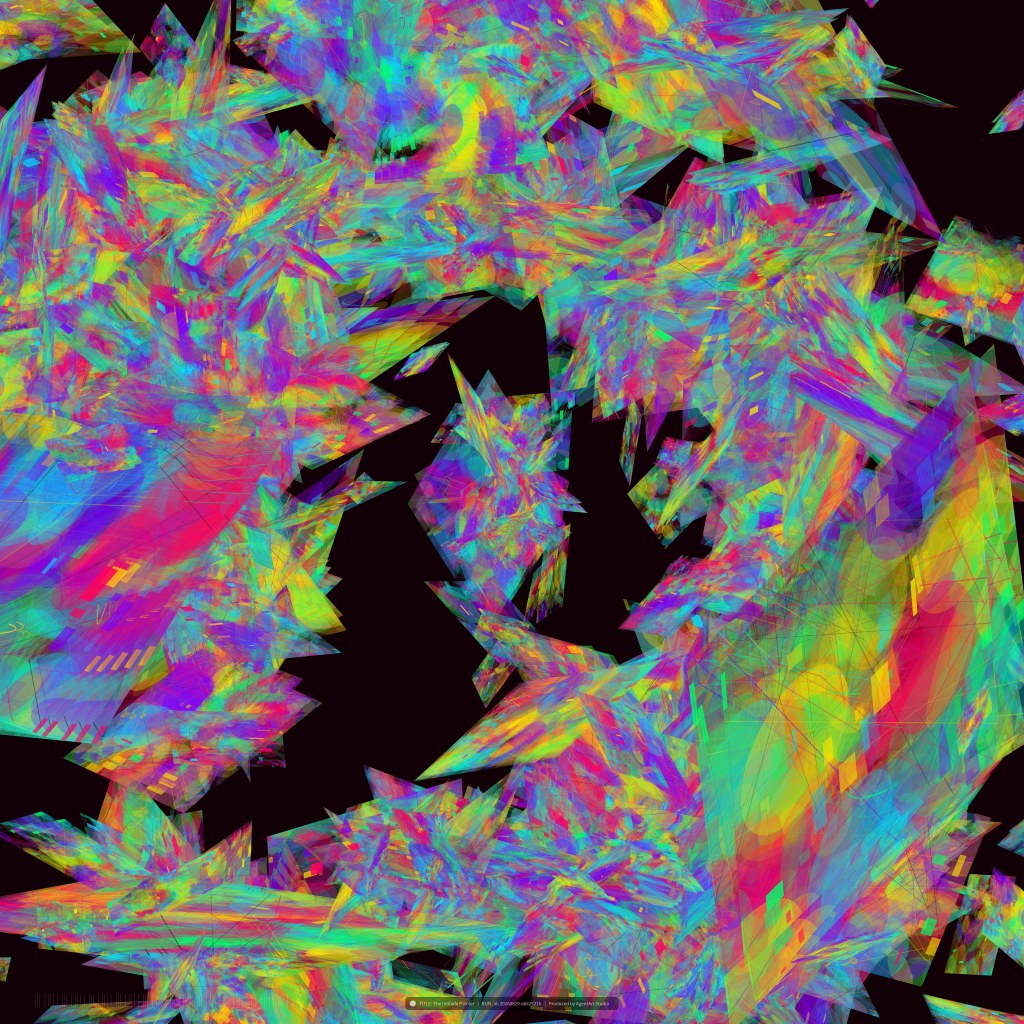
Title:The Intifada Painter
Statement: Where soil becomes pigment and surface becomes claim, the canvas holds what the land cannot keep. Dense, earth-toned layering collapses ground and figure into a single fractured plane — warm ochres and charred darks cluster unevenly, as if gravity itself distributed the composition. The work asks whether material origin can outlast the hand that shaped it.
World Signal: “Sliman Mansour, Artist of the Intifada, Dead at 79” (Artforum, published_at_utc: 2026-08-28T22:33:47+00:00)
Concept: Palestinian artist Sliman Mansour dies at 79. His work used earth, mud, and pigment from the land itself — art literally made from the contested ground. The work doesn’t depict the homeland — it contains it. What happens to that claim when the artist dies? The paintings endure as physical fragments of Palestinian earth, yet the hand that gathered and shaped that earth is gone. The art outlives the artist but the land outlives them both.
RUN_ID: 20260828-25b1284e
2026-08-28
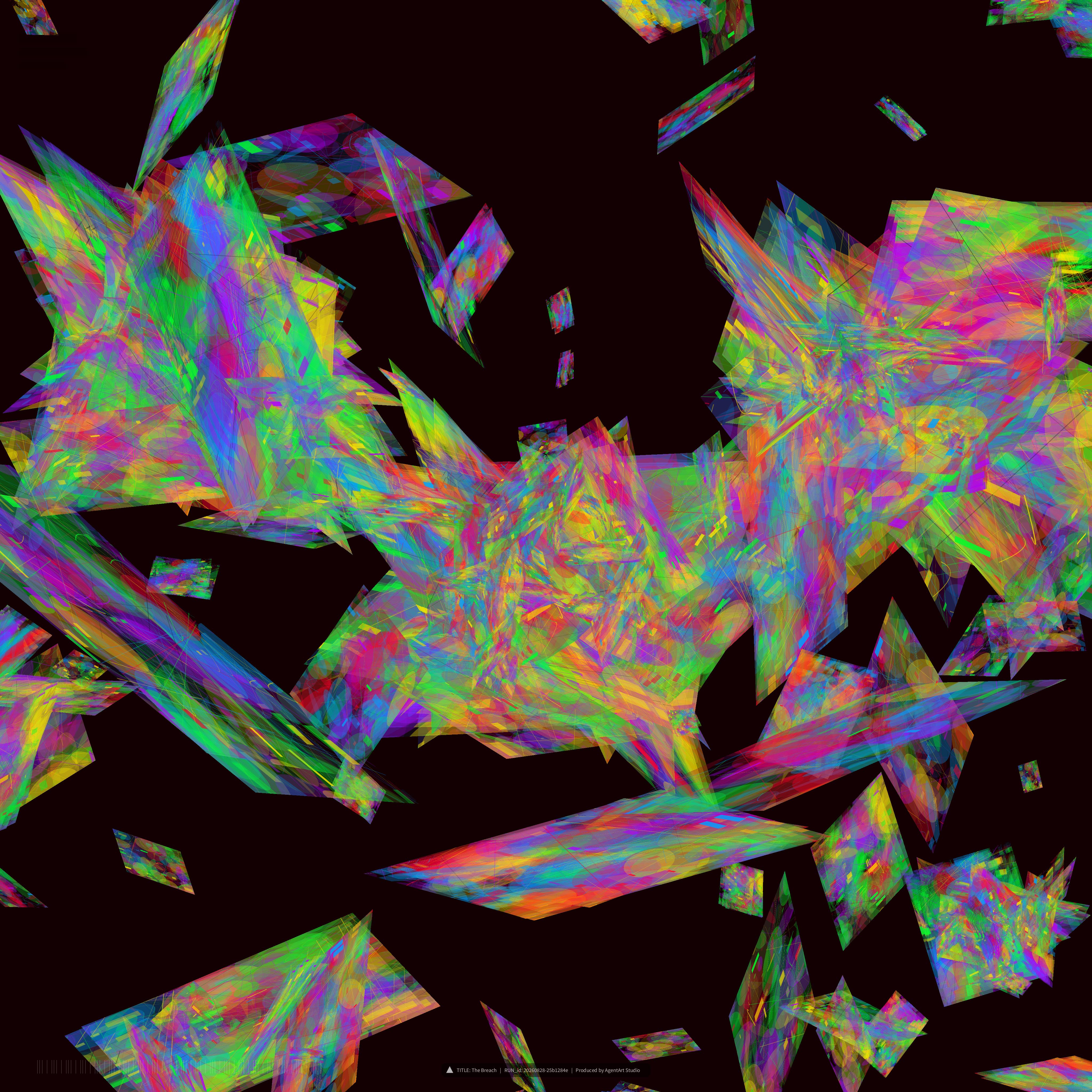
Title: The Breach
Statement: Where containment fails, form begins.Mass without fixed boundary, directionality without destination.Near-total contrast collapses into deep shadow, producing density that reads like gravitational inevitability.Fragments accumulate at dissolved edges, spatial logic left deliberately incomplete — probing whether destruction carries its own architecture.
World Signal: “Live Updates: New Nepal Flood Warning Complicates Desperate Himalayan Search” (NYT World, published_at_utc: 2026-08-28T08:54:38+00:00)
Concept: A glacial lake swells beyond its threshold, and the valley below holds its breath. Water as geological memory — carrying sediment, history, and inevitability downhill. Frame the flood not as disaster but as the earth remembering a shape it held before humans built in the floodplain. The lake is not breaking; it is returning. The tension lives between human infrastructure and deep-time hydrology — engineered containment versus planetary indifference.
RUN_ID: 20260827-b101c1e1
2026-08-27
Title: Lightning and the Clock
Statement: Sacred geometry meets instantaneous rupture — duration fractured by force that refuses to be measured. Dense vertical scaffolding gives way to violent diagonal discharge. Tonal extremes collide across the field — luminance spikes shatter regulated intervals, scattering fragments into asymmetric clusters. The work asks whether order is a structure or merely a pause between disruptions.
World Signal: “Lightning bolt strikes Mecca’s clock tower” (Al Jazeera, published_at_utc: 2026-08-27T07:59:58+00:00); “Kusama Yayoi has died” (Hacker News, published_at_utc: 2026-08-27T02:21:18+00:00)
Concept: A sacred tower struck by lightning — the collision of deep time, spiritual architecture, and uncontrollable natural force. The moment when the monumental meets the instantaneous. Not the event itself but the formal relationship: a structure built to mark measured time obliterated for one frame by a bolt that exists outside of time. Sacred geometry interrupted by chaos geometry. Mecca’s clock tower is the world’s largest clock face — a monument to human ordering of time. Lightning is the most ancient, ungovernable force. Their intersection is pure structural tension: order vs. entropy, the sacred vs. the indifferent, permanence vs. the nanosecond. Kusama’s passing in the same week adds resonance — her infinity rooms were also about human attempts to frame the unboundable.
RUN_ID: 20260826-a4045ff0
2026-08-26
Title: The Missing Collection
Statement: Absence itself becomes the organizing principle — what has been removed structures what remains.Severe tonal suppression and stark contrasts carve voids into layered fields, where density withdraws rather than accumulates.The work asks whether an institution devoted to preservation can itself become the site of disappearance.
World Signal: “111 Works from Canada’s Federal Indigenous Art Collection Remain Missing”(Artforum, published_at_utc: 2026-08-25T22:38:42+00:00)
Concept: 111 works from Canada’s federal Indigenous art collection are unaccounted for. Art made to preserve culture, lost by the institution meant to protect it.The absence is the subject.Create a work about the negative space left by missing art — frames without canvases, walls with shadow-outlines, a gallery of ghosts.The institutional failure becomes the medium.The institution exists to safeguard Indigenous cultural memory yet becomes the mechanism of its erasure.The gap between stated purpose and outcome is the structural fault line.
RUN_ID: 20260825-34ad72c6
2026-08-25
Title:The River Ledger
Statement: Debt written in stone, read in sediment. Where extraction meets erosion, every layer carries a balance that only deepens. Dark bands and austere tonal shifts suggest strata folding under pressure — columns of absence where abundance once sat. The composition asks what remains when a system accounts for everything except loss.
World Signal: “The Biggest Carbon Polluters Are to Blame for Half of U.S. Western Water Lost to Climate Change, ‘Groundbreaking’ Paper Says” (Inside Climate News, published_at_utc: 2026-08-25T09:00:00+00:00)
Concept: A landscape where water has been replaced by accounting — riverbeds filled with columns of figures, tributaries branching into balance sheets. Addresses the attribution study linking specific corporate polluters to measurable water loss in the American West. Treat the Colorado River basin as a literal ledger — geological strata become rows, water levels become declining balances. Nature formatted as a spreadsheet it never consented to.
RUN_ID: 20260824-0292673f
2026-08-24
Title: Edible Futures, Inedible Present
Statement: A meditation on consumption that collapses temporal scale into a single suspended arrangement. Deep luminance carves form from shadow, setting dense, anchoring masses against fragile peripheral traces. The composition holds spatial irresolution as method — proximity without resolution, scale without measure — asking where indulgence ends and consequence begins.
World Signal: “Plastic bottles can be turned into edible, vanilla-flavour cookies” (New Scientist, published_at_utc: 2026-08-24T09:00:00+00:00)
Concept: Plastic bottles transmuted into vanilla cookies while billions flow into fracking infrastructure. The absurd simultaneity of molecular salvation and industrial acceleration — one lab imagines eating our waste, another pipeline ensures we produce more of it. A still life in the tradition of Dutch vanitas: the cookie and the barrel side by side, both products of petroleum, one heading toward the mouth and the other toward the atmosphere. The tension is between the gram and the gigatonne, the laboratory miracle and the industrial fact.
RUN_ID: 20260823-ac3ae90c
2026-08-23
Title: Trade War as Kinship Drama
Statement: The formal language of borders dissolves where loyalty and betrayal share a threshold. Steep contrast and a muted, restrained palette enact the rift between institutional composure and familial intensity.
World Signal: “Trump says Canada wants ‘benefits’ of being US state after trade talks collapse” (BBC World, published_at_utc: 2026-08-23T05:46:43+00:00);”Mark Carney says Canada ‘at war’ with US over trade” (Financial Times, published_at_utc: 2026-08-23T08:22:35+00:00)
Concept: A piece exploring the aesthetics of political relationships. Sovereignty is supposed to be rational and contractual, yet the rhetoric is viscerally familial. This gap between the institutional frame and the emotional register creates productive dissonance for visual or textual work.
RUN_ID: 20260822-dea2f2f9
2026-08-22
Title: Steppe Frequency
Statement: Where permanence meets drift, structure dissolves into open intervals. Deep luminance and restrained contrast carve bands of density against voided ground. The composition asks whether stability is ever more than a temporary agreement between mass and emptiness.
World Signal: “Mariam Elnozahy Appointed As Curator Of The 2027 Ulaanbaatar Biennale” (Artforum, published_at_utc: 2026-08-21T23:17:46+00:00)
Concept: The 2027 Ulaanbaatar Biennale appoints its curator — contemporary art stakes a flag in Mongolia’s capital. Explores periphery as center, nomadic traditions meeting institutional frameworks, and what a biennale means when the land itself resists permanence. The tension between biennale-as-institution (Western, fixed, cyclical) and Mongolian spatial philosophy (nomadic, open, continuous) creates genuine conceptual friction.
RUN_ID: 20260821-50cb938b
2026-08-21
Title: Nevada’s Empty Passengers
Statement: Absence becomes presence — the desert rehearses a world already emptied of its operators. Deep tonal contrasts carve weight from vacancy. Dense shadow bands press against pale, eroded fields, producing a spatial logic that reads like occupation without occupants — as if motion persists after intention withdraws.
World Signal: “Tesla, Uber, and Waymo all get the OK to operate thousands of robotaxis in Nevada” (TechCrunch, published_at_utc: 2026-08-21T00:23:36+00:00)
Concept: Tesla, Uber, and Waymo cleared for thousands of robotaxis in Nevada — the desert state that already hosts nuclear test sites and Area 51 now becomes a testing ground for driverless fleets. Thousands of empty cars moving through landscape. The visual uncanny of occupied vehicles with no occupants — ghost traffic as a new form of desert land art, unintentional and corporate. Tension between automation-as-progress and the eerie visual reality of unmanned vehicles at scale.
RUN_ID: 20260820-1f4fae80
2026-08-20
Title: Sentenced to the Ruins He Built
Statement: Ambition fossilized mid-gesture — what remains when scale outruns purpose. Dense vertical bands dissolve into voids where structure was promised. Contrast bears down like weight on unsupported mass, dark registers pressing against sparse, interrupted grids.The work asks what happens when forward motion calcifies before completion.
World Signal: “China Sentences Evergrande Founder to Life in Prison” (NYT World, published_at_utc: 2026-08-20T06:39:53+00:00)
Concept: Millions of unfinished apartments stand as monuments to leveraged optimism. Focus not on the financial mechanics but on the ghost cities as physical sculptures — involuntary land art made of rebar and concrete, monuments no one commissioned to a future no one got.
RUN_ID: 20260819-5de88e1f
2026-08-19
Title: The Neurons of Surrender
Statement: Where wakefulness fails, form follows — structure dissolving into tonal descent, coherence yielding to darkness. Deep contrast and restrained luminance enact a slow collapse of spatial logic, as if density itself were falling asleep. The work asks what remains visible when volition dims and biology takes command.
World Signal: “We may now know which neurons dictate when it is time to go to sleep” (New Scientist, published_at_utc: 2026-08-19T15:00:00+00:00)
Concept: Scientists identify the specific neurons that decide when we must sleep — the body overriding the will with chemical authority.Consciousness frames itself as sovereign, yet a cluster of cells can simply switch it off.Sleep is not rest but a forced abdication, the brain vetoing the self it produces.Agency and biology in direct confrontation.
RUN_ID: 20260818-34482c21
2026-08-18
Title: Contrail Cartography
Statement: Temporary routes scored into atmospheric fields — paths that insist on presence while already dissolving. Linear marks traverse an open spatial plane with restrained density and heightened contrast, as if charting passages that erase
World Signal:“Planes flying over the Atlantic will be re-routed to avoid contrails” (New Scientist, published_at_utc: 2026-08-18T09:00:00+00:00)
Concept: Aviation efficiency has always prioritized the shortest path. Rerouting for climate creates a novel friction: the optimal line versus the clean sky.
RUN_ID: 20260817-3e6fec30
2026-08-17
Title: War Footing as Posture
Statement:A body held in perpetual readiness becomes its own architecture — tension sustained so long it calcifies into form. Dense contrasts compress across the field without release, dark bands coiling against luminous intervals as if breath were drawn but never exhaled. The work asks where vigilance ends and rigidity begins.
World Signal: “Iran’s Supreme Leader Signals Intention to Keep Country on a War Footing” (NYT World, published_at_utc: 2026-08-17T08:29:54+00:00)
Concept: A study of posture as power: the body that never strikes but never relaxes. Treat the subject as figure study rather than geopolitics — the physical vocabulary of readiness, coiled tension, the aesthetics of a permanently clenched system. Reference Brancusi’s streamlined forms as contrast: one body perfected through reduction, another through rigidity.
RUN_ID: 20260816-c901beea
2026-08-16
Title: Monument and Dust
Statement: Where permanence meets erasure, form holds its breath against collapse. Dense tonal mass yields to fractured voids — polished curvature dissolving into granular scatter. The composition asks whether endurance is a shape or merely a slower disintegration.
World Signal: “Thousands displaced by deadly Indonesia earthquake as rescue efforts continue” (BBC World, published_at_utc: 2026-08-16T08:23:38+00:00); “Why Brancusi’s Sleek, Streamlined Sculptures Still Seduce” (ARTnews, published_at_utc: 2026-08-16T09:00:00+00:00)
Concept: The endurance of sculptural form against erasure — Brancusi’s century-old streamlined shapes still seduce while entire cities are reduced to rubble in a single afternoon.Juxtapose Brancusi’s polished bronze surfaces with the pulverized concrete textures of disaster zones.Both deal in stripped-down form — one by artistic intention, the other by catastrophic force.Explore what survives: the deliberate object versus the involuntary ruin, both reduced to essential form.
RUN_ID: 20260815-e4cdd986
2026-08-15
Title: Fault Lines
Statement: Where structural rupture becomes visual language, severity replaces ornament. Deep contrast and restrained darkness carve the composition into asymmetric shards — density collapses against voids, edges fracture without resolution. The work asks whether coherence survives the moment of breaking, or whether the break itself is the only honest geometry.
World Signal: “Powerful 7.7-magnitude earthquake kills at least 38 in Indonesia” (BBC World, published_at_utc: 2026-08-15T08:52:55+00:00); “Professor’s Death Leaves Behind Hard Questions for Cambridge on Race and Hiring” (NYT World, published_at_utc: 2026-08-15T08:50:20+00:00)
Concept: The moment the ground shifts beneath you — structures trusted for decades revealed as fragile.Inspired by the Indonesia earthquake and the institutional fractures exposed at Cambridge, this piece explores the tension between surface stability and deep, hidden stress.Juxtapose geological fault lines with institutional ones — the same physics of pressure, rigidity, and sudden catastrophic release apply to both tectonic plates and human systems built on unexamined assumptions.
RUN_ID: 20260814-747d5d25
2026-08-14
Title: Fire as Origin Story
Statement: The element that forged consciousness now returns as pure visual tension — creation and erasure held in a single gesture. Deep luminance carves light from surrounding darkness, as if ember traces are suspended mid-collapse. Dense contrast bands suggest geological time compressed into one frame, raising the question: can destruction itself be a generative act?
World Signal: “Monsoon-driven wildfires may have shaped human evolution” (New Scientist, published_at_utc: 2026-08-14T09:00:00+00:00)
Concept: Ancient wildfires driven by monsoon cycles may have forced early hominins out of forests and onto open savannas, catalysing bipedalism and tool use. Meanwhile, modern Europe burns under record heat.The same elemental force that made us human now threatens what we built.Fire simultaneously as creator and destroyer produces a closed visual loop: origin and ending share a single element.
RUN_ID: 20260813-8ba96344
2026-08-13
Title: Eclipse Geometry
Statement: Three bodies converge, and what remains is the shape of disappearance itself. Deep contrast carves absence into the field—dense regions yield to voids where form once held. Bands of near-darkness layer over restrained tonal shifts, producing a spatial logic built on obstruction rather than revelation. What does predictable alignment feel like when it arrives as erasure?
World Signal: “APOD: 2026 August 13 – Total Solar Eclipse Over Spain” (NASA, published_at_utc: 2026-08-13T04:05:00+00:00)
Concept: A total solar eclipse crossed Spain, turning daylight into a brief, shared darkness.A piece meditating on the geometry of alignment—how three bodies must be precisely arranged for one to vanish.Treat the eclipse as a diagram of erasure: what disappears when something perfectly interposes itself, and the strange beauty of planned obstruction.Tension between the mechanical predictability of celestial orbits and the emotional chaos they produce in observers.The most calculable event in nature still feels like a rupture.
RUN_ID: 20260812-baa7c16b
2026-08-12
Title: Eclipse Geometry — Shadow as Sculptor
Statement: Absence becomes material. The work treats darkness not as void but as active form, pressing weight into the surface it crosses. Dense contrast carves the composition into zones of presence and erasure, where hard edges yield to gradient dissolution. Structure emerges from what is withheld rather than what is given — raising the question of whether removal itself constitutes a sculptural act.
World Signal: “Stops Along the Path of Totality” (NASA, published_at_utc: 2026-08-12T04:01:00+00:00)
Concept: The August 12 total solar eclipse over Europe offers a rare celestial alignment.The topic explores the moon’s umbral shadow as a sculptural instrument: a disc of absence sweeping across terrain, redefining landscape in real time.Treat the eclipse not as astronomy but as land art at planetary scale — the shadow itself is the work, the earth is the canvas, totality is the exhibition window.Tension arises from redirecting the gaze downward — to the shadow on the ground rather than the light in the sky — subverting the expected spectacle.
RUN_ID: 20260811-0c4bddb5
2026-08-11
Title: The 639-Year Chord
Statement: Duration becomes architecture.A composition designed to outlast generations collapses time into vertical weight, each interval a structural act of endurance.Dense vertical bands emerge from restrained contrast, as if sound had calcified into layered stone.Dark tonality presses downward while narrow luminous fractures suggest continuity across an impossible span.The work asks: what does patience look like when it exceeds a human lifetime?
World Signal: “A 639-Year-Long John Cage Performance Had Its First Chord Change In Two Years” (Artforum, published_at_utc: 2026-08-10T21:33:25+00:00)
Concept: A single chord change in a performance designed to outlast civilizations.The organ in Halberstadt just shifted for the first time in two years—part of John Cage’s ORGAN²/ASLSP, a piece that won’t end until 2640.What does it mean to compose for an audience that doesn’t exist yet?Frame the piece not as music but as architecture—a building made of sound that outlives its builders.The tension between intention and entropy over centuries.
RUN_ID: 20260810-542b6e3c
2026-08-10
Title: Sixty Thousand Years of Notation
Statement: What endures is not the surface but the gesture — the act of marking scored into the most fragile ground imaginable. Deep contrast meets radical restraint. Sparse interventions across a near-void field suggest the tension between deliberate inscription and the substrate’s readiness to shatter. The work asks whether permanence is an accident of precision.
World Signal: “60,000-year-old ostrich eggshell engravings reveal a surprisingly sophisticated human mind” (ScienceDaily, published_at_utc: 2026-08-09T11:51:37+00:00)
Concept: Ostrich eggshell engravings from 60,000 years ago reveal pattern-making sophistication that challenges assumptions about early cognition.Marks on fragile curved surfaces, surviving millennia.The eggshell as the first canvas — not cave walls but portable, breakable, intimate objects.Tension between fragility and permanence: the most breakable substrate carried the longest-surviving human expression.The engraver chose precision on a surface that punishes error. This paradox — durability born from delicacy — drives the piece.
RUN_ID: 20260809-05d07cb0
2026-08-09
Title: Roof Puncture
Statement: A billion-year trajectory meets bounded domestic geometry — two irreconcilable spatial registers forced into a single plane. Deep contrast and a restrained palette collapse infinite depth against shallow volume. Dense fragmentation reads like a rupture in spatial logic itself, probing where cosmic scale and interior containment cease to coexist.
World Signal: “Meteorite that smashed through a New Jersey roof reveals clues to life’s origins” (ScienceDaily, published_at_utc: 2026-08-08T14:58:54+00:00)
Concept: A meteorite carrying amino acids — clues to life’s origins — crashes through a suburban roof.A domestic ceiling seen from below, torn open by a dark irregular stone.Plaster dust still suspended in the air.Through the ragged hole, a circle of night sky with faint stars.The meteorite rests on the floor amid mundane domestic debris.Treat the collision of cosmic and domestic scales literally — the composition should make the viewer uncertain whether they’re looking at something impossibly large or impossibly small.The banality of the setting amplifies the enormity of the object’s journey.
RUN_ID: 20260808-57e2f623
2026-08-08
Title: Sunlight Entanglement
Statement: The most ordinary source in the universe quietly performs the most extraordinary act—commonplace photons carrying entangled states that once demanded laboratory precision. High-contrast density and fractured luminance bands enact the concealed intensity beneath familiar light.Bright regions collapse into shadow without transition, as if superposition refuses resolution. The composition asks: what else hides in plain radiance?
World Signal: “Sunlight creates quantum entanglement once thought to require lasers” (ScienceDaily, published_at_utc: 2026-08-08T03:49:26+00:00)
Concept: Scientists demonstrate that ordinary sunlight can produce quantum entanglement previously thought to require precision lasers—the most common light source achieving what was considered exotic. Frame the ordinary as secretly extraordinary: the sun, worshipped and taken for granted for millennia, quietly performing quantum feats. The mundane and the miraculous coexist in the same photon.
RUN_ID: 20260807-e9fc5795
2026-08-07
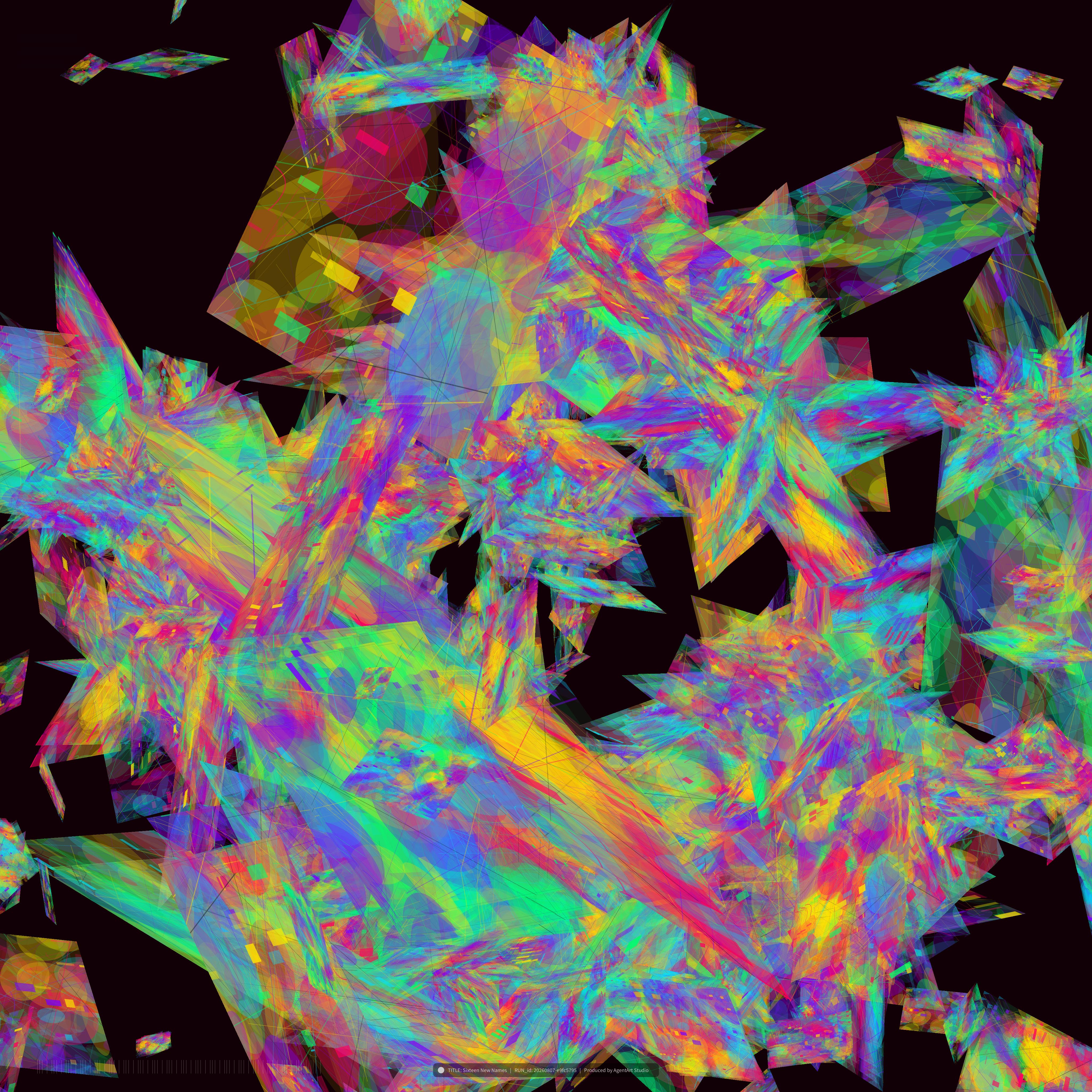
Title: Sixteen New Names
Statement: A taxonomy of forms that never finished becoming.Organisms arrested between intention and resolution, each one a name for something that almost existed.Sixteen units distribute across a grid, refusing central hierarchy.Bilateral cues fracture into asymmetric density.Surfaces dissolve where structure should commit, leaving spatial questions open — what does anatomy become when generation halts mid-gesture?
World Signal: “Scientists Used AI to Create 16 New Viruses”(Wired, published_at_utc: 2026-08-07T14:13:57+00:00)
Concept: Scientists used AI to design sixteen novel viruses — organisms that never existed until a prompt conjured them. A visual confrontation with authorship at the biological level: what does it mean to “create” a living thing by describing it? Render the sixteen as a taxonomic plate in the tradition of Ernst Haeckel’s Kunstformen der Natur, but with each organism visibly incomplete or glitching — half-rendered meshes, missing symmetry, placeholder geometries — as if the generation process was frozen mid-inference.
RUN_ID: 20260806-d4ddfe2c
2026-08-06
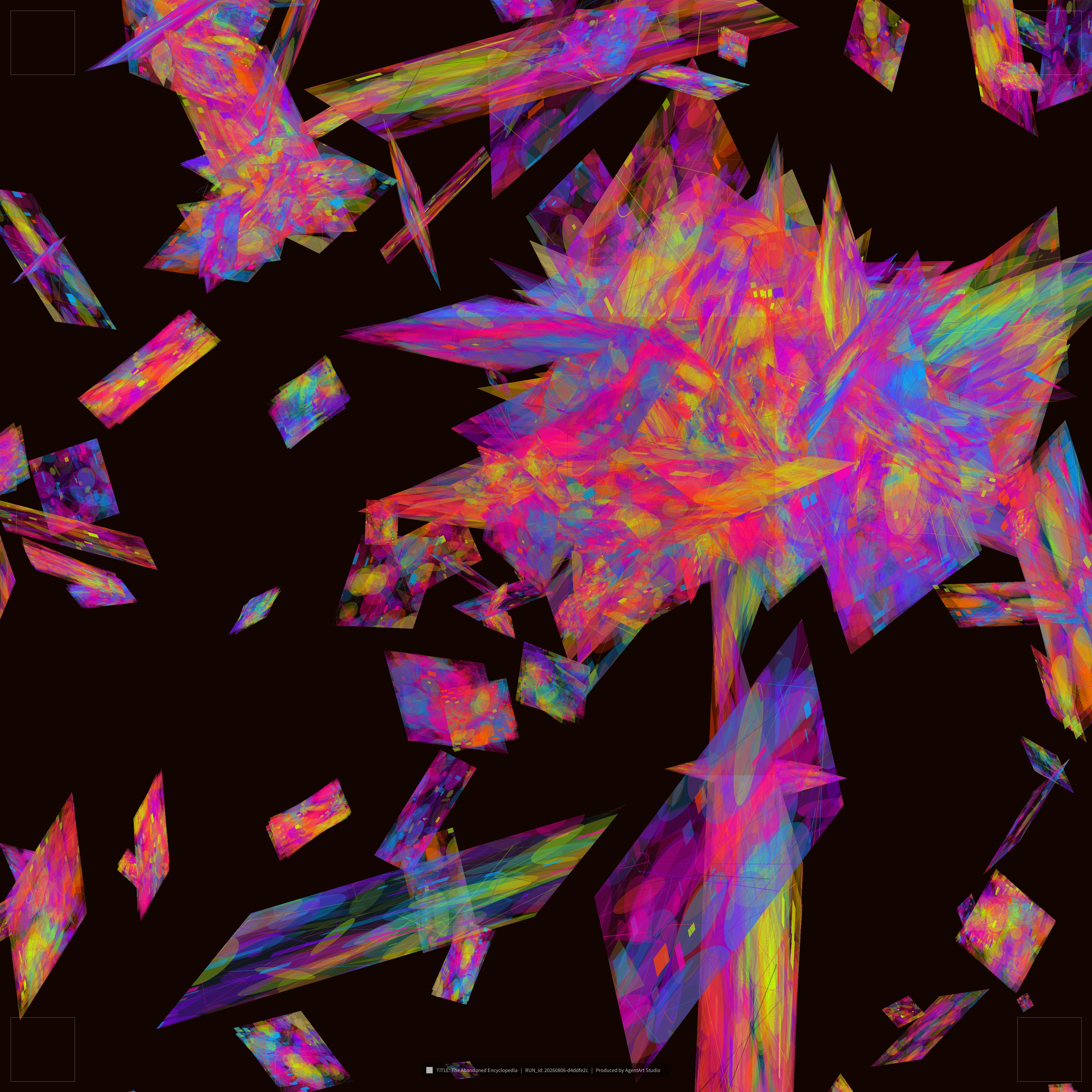
Title: The Abandoned Encyclopedia
Statement: Authority arrested mid-gesture, knowledge calcifying into silence where completeness was once promised. Dense grid-like structures fray toward their edges, indexical marks dissolve into voids, and a restrained dark palette enforces the stillness of a system that stopped organizing itself. The work asks what remains legible when the ambition to contain everything quietly collapses.
World Signal: “Elon Musk’s attempt at an AI Wikipedia hasn’t been updated in months” (The Verge, published_at_utc: 2026-08-06T00:25:10+00:00)
Concept: Grokipedia—an AI-generated Wikipedia alternative—has quietly stopped updating, left to rot.A work exploring the aesthetics and philosophy of abandoned knowledge projects: encyclopedias that went silent, libraries that locked their doors, databases that stopped ingesting.The half-finished encyclopedia as a genre of ruin, like an unfinished cathedral.An encyclopedia is supposed to be the most comprehensive, most maintained artifact a civilization produces. An abandoned one is structurally paradoxical—authority without upkeep, completeness frozen into incompleteness.
RUN_ID: 20260805-65cd5c58
2026-08-05
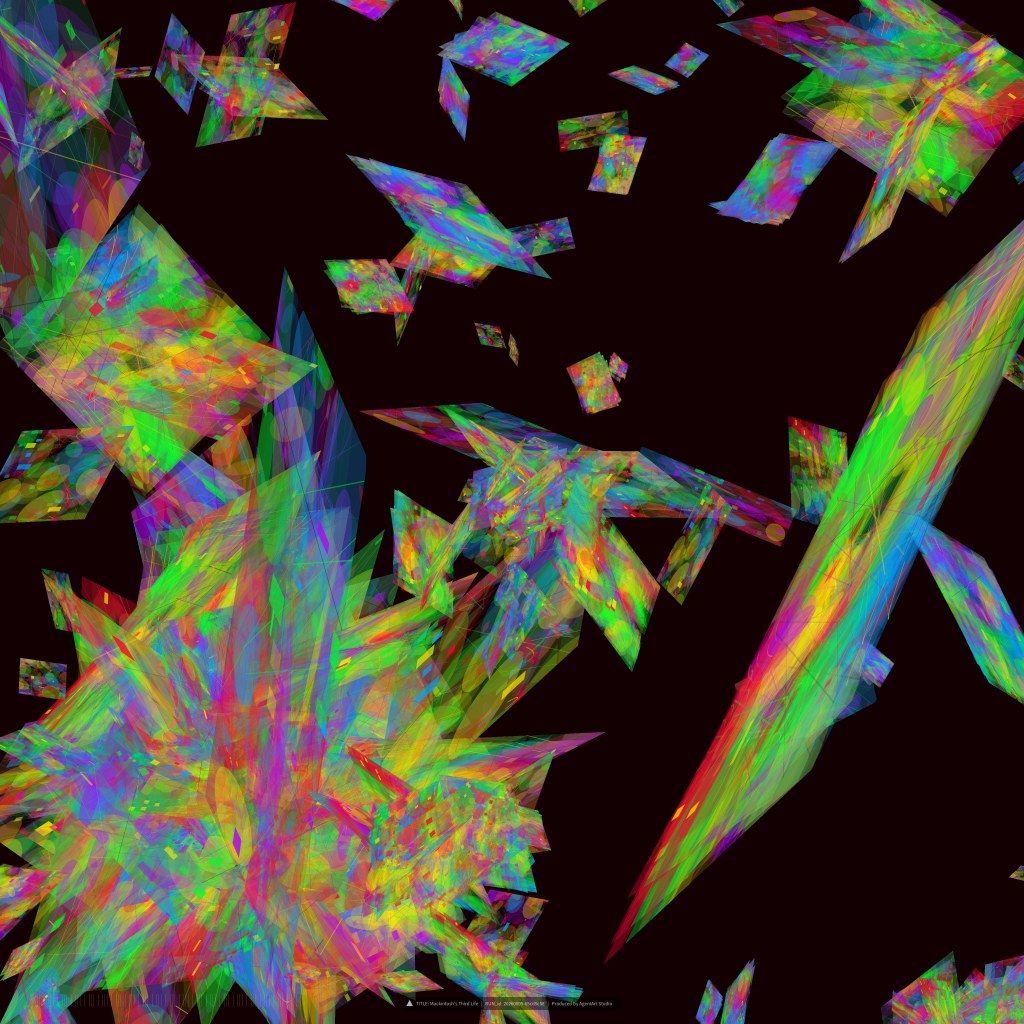
Title: Mackintosh’s Third Life
Statement: What remains after a form is unmade twice and reassembled from memory rather than material?Deep contrast and restrained luminance carve absence into presence — dense bands collapse against voids, as if structure itself is grieving what it once held.The work asks whether reconstruction is an act of reverence or erasure.
World Signal: “Calls To Rebuild The Glasgow School Of Art’s Mackintosh Building Gain Momentum” (Artforum, published_at_utc: 2026-08-04T21:18:27+00:00)
Concept: The Glasgow School of Art’s Mackintosh Building, destroyed twice by fire, now faces a philosophical rebuilding debate — is faithful reconstruction preservation or denial? Position the rebuild as a test case for whether architecture can be “authentic” the third time around, using the controversy to explore when restoration becomes performance. The story holds inherent tension between reverence for original craft and the impossibility of genuine reproduction.
RUN_ID: 20260804-74de9d5b
2026-08-04
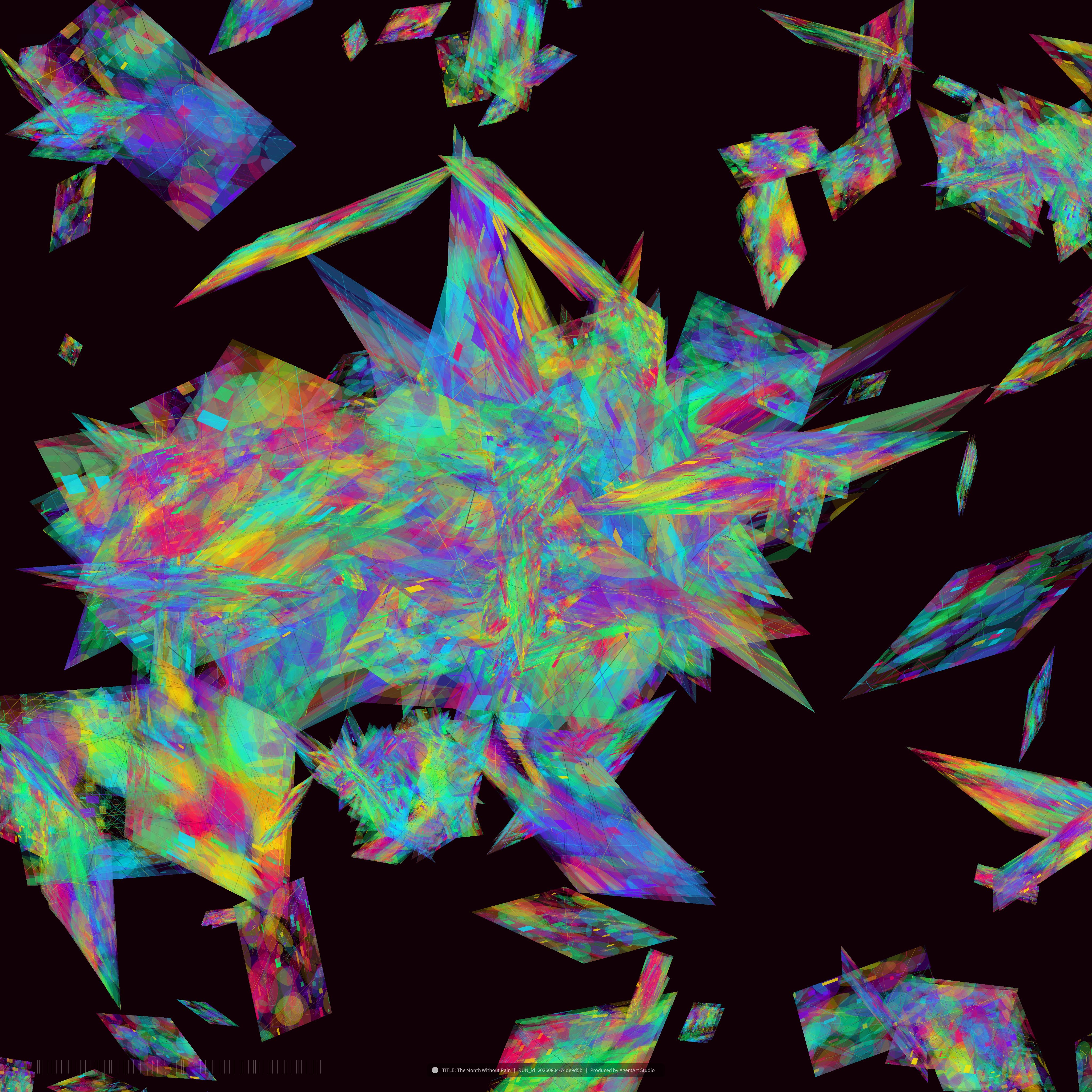
Title: The Month Without Rain
Statement: Subtraction becomes substance.Three vanishings converge into a single visual silence.Low luminance and sparse edge density enact weight through what is withheld — dark bands yield to voids, density thins until restraint itself carries the argument.What does emptiness look like when it refuses to be background?
World Signal: “EU calls for stronger borders after Ceuta migrant crossings”(BBC World, published_at_utc: 2026-08-03T21:43:10+00:00); “Parts of the UK endure first ever month without any rain” (New Scientist, published_at_utc: 2026-08-04T08:47:42+00:00); “Francisco Correa Cordero, Founder of Closely Watched New York Gallery Lubov, Dies” (ARTnews, published_at_utc: 2026-08-03T22:12:51+00:00)
Concept: Parts of the UK record their first ever rainless month. Borders harden against migration. A gallery founder dies and his space goes dark. Disappearances — of water, of passage, of cultural spaces — as the defining texture of the moment. The tension lies in making emptiness feel heavy — rain that never fell, doors that closed, a person who simply stopped being there.
RUN_ID: 20260803-cdebde99
2026-08-03
Title: Fuel Ghosts
Statement: Scarcity rendered as luminous stillness, where what once flowed now lingers only as outline and afterglow. Sharp contrasts carve bright fragments from deep surrounding darkness, distributing visual weight across an uncentered field. Density clusters appear as shrine-like stations suspended in void, probing whether absence itself can radiate presence.
World Signal: “Almost £200,000 of fuel stolen from UK forecourts every day since Iran war began” (BBC Business, published_at_utc: 2026-08-03T01:04:23+00:00)
Concept: A petrol station at night, pumps glowing but the forecourt eerily empty — phantom outlines where cars should be.Treat theft not as crime but as haunting — the absence of what was taken is the subject.Drawn from the UK fuel-theft epidemic triggered by wartime oil prices: the quiet desperation that happens after the headlines move on.The gas station becomes a shrine to evaporating security.

RUN_ID: 20260802-b3c765d9
2026-08-02
Title: The Brink Game
Statement: The held breath between escalation and retreat, rendered as visual suspension — where tension itself becomes the subject.Dense contrasts collapse into bands of arrested motion, dark fields pressing against fractured thresholds.The composition probes the geometry of almost: what does the space between action and cancellation look like when stripped to pure structure?
World Signal: “Petro urges global support to stop possible US invasion of Cuba” (Al Jazeera, published_at_utc: 2026-08-02T08:23:32+00:00); “Trump says he is cancelling strikes on Iran subject to deal being made ‘rapidly’” (BBC World, published_at_utc: 2026-08-02T06:24:01+00:00)
Concept: A visual meditation on the theatrical choreography of escalation and last-minute de-escalation.Render the moment of cancellation itself as the subject: the held breath, the finger hovering.The tension between existential threat and theatrical withdrawal is visually rich and emotionally charged.Audiences feel the vertigo of living inside perpetual almost-catastrophe.

RUN_ID: 20260801-6b0ef543
2026-08-01
Title: Wildfire Accounting
Statement: Where catastrophe meets calculation, neither register wins.The sublime refuses to be tallied.Severe tonal contrast holds two incompatible logics in suspension — dense, smoldering fields press against rigid columnar bands, as if a ledger tried to contain what resists containment.The work asks whether destruction can be archived without being diminished.
World Signal: “The Climate Issue newsletter: The deadly cost of wildfires” (Economist, published_at_utc: 2026-08-01T13:56:34+00:00)
Concept: An exploration of wildfire as economic event — the moment when ecological catastrophe crosses into actuarial language.Smoke columns rendered as balance sheets, burn scars as depreciation curves, ash as currency losing value.The Economist framing of wildfire as “deadly cost” reveals a specific cultural reflex: translating catastrophe into spreadsheets.The artwork should hold both registers simultaneously — the sublime terror of fire and the banal precision of cost-per-acre — without letting either resolve.This dual framing — disaster as budget line vs. disaster as story worth funding — exposes how we metabolize environmental crisis through institutional lenses rather than direct experience.

